What Your Swollen Feet Are Asking For: An Herbal Foot Soak for Pregnancy & Postpartum
May 15, 2026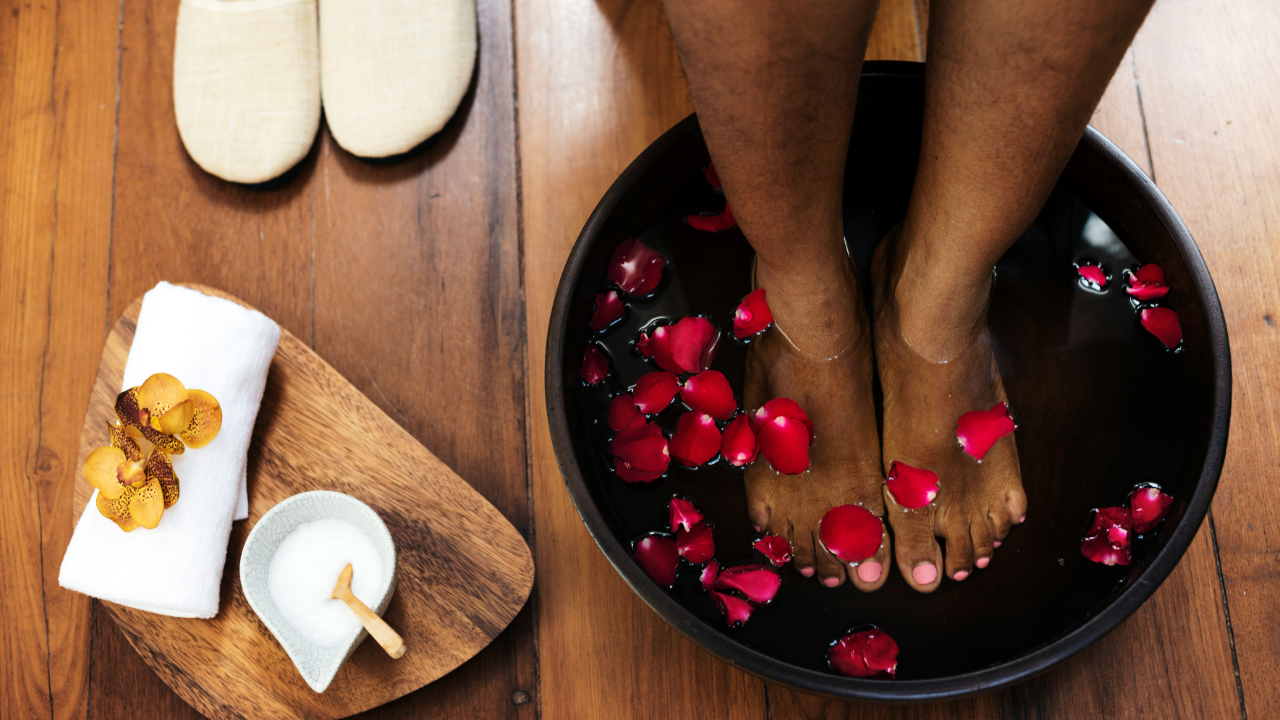
There is a sound I have learned to listen for.
A woman settles into the chair — the one she always loves — and her feet lower into the warm water. And then: an audible exhale. Involuntary. Her body responding before her mind catches up. Something in her releases. Just slightly. Just enough.
That sound is body literacy in real time. It is her nervous system recognizing something ancient — warmth, water, plant medicine — and saying, without words: I am safe here. I can soften.
I built the herbal foot soak at The Threshold Body because I believe the beginning of a session is as sacred as the session itself.
A personal note
My Daughter and the Basin of Warm Water
I want to tell you something personal before I tell you anything clinical. My daughter and I do herbal baths together. We both have some skin stuff — the kind that flares up and asks for tending — and when it gets to be pretty bad, I draw a milk bath with herbs and we get in together. She loves them. They are some of the most beautiful, quiet moments of our life. There is something that happens in that water. Something that has no clinical name and doesn't need one. We are both held. We are both warm. The herbs are doing their ancient, unhurried work on our skin. And we are just — together. Present. Unhurried. In a world that is always asking us to be somewhere else. I know that one day she will be too old to get in with me. I think about that sometimes, the way mothers think about all the lasts that arrive without announcing themselves. It makes me hold those moments more carefully.
"Warmth, water, and plant medicine are among the most reliable companions a woman's body has ever had. They were here long before wellness culture named them."
I tell you this because the herbal foot soak is not something I invented from a textbook. It is something I live. It is something my body knows, and something I have watched many women's bodies recognize the moment their feet touch the water.
ANCIENT WISDOM
Why the Feet? Why Water?
Long before massage therapy was a licensed profession, long before wellness became an industry, women were soaking their feet in warm herb-infused water and feeling the relief move through their whole bodies. This is not a trend. This is a tradition that spans cultures and centuries — and your body already knows it.
In Traditional Chinese Medicine
The feet are understood as a direct pathway to the womb. The warmth of the feet is intimately connected to the warmth of the uterus — which means a foot soak is not just foot care. It is womb care. When the lower body is warmed and circulation is invited to move freely, the pelvic region benefits too. Soaking the feet up to the mid-calf is believed to stimulate flow in the lower body, supporting uterine health and — in the postpartum period — healing and recovery.
In Ayurveda
One of the foundational principles of postpartum recovery in Ayurveda is the reduction of Vata — the cold, mobile, airy energy that rises dramatically after birth. Warmth is the antidote. Herbal soaks, warm oils, and grounding rituals are central to the Ayurvedic tradition of postpartum care because they restore what the body loses in the tremendous expenditure of giving birth. Birth is considered a cold event — and warming the body, from the feet up, is how you begin to bring her home.
In the Body's Own Language
Warm water signals safety to the nervous system. It is one of the most primitive and reliable ways to move a body from the state of holding — of bracing, managing, performing — into the state of receiving. When a woman is warm, held, and unhurried, her body shifts. Her breath deepens. Her muscles soften. Her nervous system, which has been standing watch, is allowed to rest. This is not metaphor. This is physiology. And it is the reason the foot soak comes before the massage — not as a bonus, but as the first gesture. An invitation for her body to arrive before the session begins.
THE MINERAL FOUNDATION
What the Salt Does (and Why It Matters for Swelling)
Every soak begins with Epsom salt — magnesium sulfate — and this is not incidental. It is foundational. Up to 80% of pregnant women experience edema — swelling of the feet, ankles, and hands. As the body increases its total fluid volume by six to eight liters during pregnancy, excess fluid can pool in the lower extremities, creating the heaviness, tightness, and tenderness that many pregnant women know intimately. The kind that makes shoes feel like weapons by the end of the day. Magnesium sulfate, dissolved in warm water, offers real relief.
Research suggests it absorbs through the skin and can:
- Reduce water retention by drawing excess fluid out of the tissues
- Improve circulation to relieve puffiness in the feet and ankles
- Relax smooth muscles and ease leg cramps — one of the most common and most disruptive complaints in pregnancy
- Regulate neurotransmitters, contributing to a genuine felt sense of calm
- Replenish magnesium — a mineral many pregnant women are deficient in, essential for muscle function, nerve regulation, and blood pressure
One small clinical trial found that daily Epsom salt foot soaks produced nearly 75% improvement in prenatal edema — compared to 55% from foot exercises alone. A meaningful difference when your feet feel like they belong to someone else. For the postpartum body, magnesium sulfate continues to do important work: relaxing muscles that are sore from labor and recovery, supporting circulation as the body recalibrates its fluid balance after birth, and offering the anti-inflammatory support that a healing body is always asking for.
PLANT MEDICINE
The Prenatal Herbs and What They Offer
The herbs layered into a prenatal soak are chosen based on your specific symptoms at each session — not a fixed formula. Every blend is personalized to where you are that day. Here are the herbs I work with and why.
A note on safety: all herbs in these soaks are applied topically, not ingested. Topical application carries a very different safety profile than oral use. All herbs listed here are considered appropriate for topical application during pregnancy. As always, consult your midwife or OB with any specific concerns.
Lavender For the nervous system, rest, and tension relief
Lavender is one of the most well-studied herbs for stress reduction and sleep support. Its calming compounds — absorbed through the skin and through gentle inhalation as the steam rises — signal the nervous system to downregulate. For a pregnant woman whose nervous system is already working overtime, lavender offers something simple and profound: a reminder that she is safe, that she can soften, that her body is doing what it was made to do.
Chamomile For inflammation, restless legs, and the particular tired-anxious of late pregnancy
Chamomile is rich in calcium and magnesium, and carries gentle anti-inflammatory properties that complement the Epsom salt base beautifully. It has been used across cultures and centuries to soothe irritability, physical tension, and restlessness. For swollen, restless, aching feet — especially in the third trimester — chamomile in warm water is a quiet revolution.
Peppermint For swelling, heaviness, and overheating
Peppermint's cooling properties make it especially valuable for prenatal swelling and the heat discomfort of late pregnancy. Applied topically to the feet, it helps reduce the sensation of heaviness and provides gentle circulatory stimulation to support the movement of fluid. The aromatic steam also offers well-documented nausea relief — a welcome side effect for many.
Nettle For mineral nourishment and whole-body pregnancy support
Nettle is one of nature's most mineral-dense plants — containing vitamins A, C, and K, plus calcium, potassium, and iron. It is a cornerstone herb in midwifery and has been used for generations to support pregnancy health. In a foot soak, its minerals are available for gentle transdermal absorption, nourishing the body in the quiet, unhurried language that plants have always spoken.
Ginger For poor circulation, cold feet, and nausea relief through aromatic steam
Ginger is warming, circulatory, and grounding. For women experiencing cold extremities, sluggish circulation, or that persistent low-grade nausea that seems to live in the body rather than the stomach — the warming steam of ginger in a foot soak can offer real relief. It is one of the most extensively studied herbs in pregnancy, with a strong safety record at appropriate amounts.
PLANT MEDICINE
The Postpartum Herbs and What They Offer
The postpartum body is not simply a pregnant body that has delivered. It is a body in profound transition — navigating physical healing, hormonal recalibration, sleep deprivation, milk coming in, and the seismic identity shift that is matrescence. These herbs are chosen to meet that body with specificity and care.
A note on safety: all herbs in these soaks are applied topically, not ingested. Topical application carries a very different safety profile than oral use. All herbs listed here are considered appropriate for topical application during pregnancy. As always, consult your midwife or OB with any specific concerns.
Lavender For nervous system regulation, sleep support, and emotional tenderness
The postpartum nervous system is running a marathon while recovering from a birth. Lavender's ability to support the parasympathetic state — the rest-and-digest, the I can exhale now — makes it one of the most valuable herbs available to a new mother. Its aromatherapy properties support mood, ease anxiety, and invite the kind of deep exhale that new mothers rarely get to take. It is associated with improved sleep quality, which makes it especially precious in the early postpartum weeks when sleep is its own kind of survival
Chamomile For after-pains, inflammation, and the emotional intensity of early motherhood
Chamomile's anti-inflammatory properties are particularly welcome in the postpartum body, where after-pains and soreness are the daily landscape. It also carries a quality that is harder to name but just as real: a deep soothing of the emotional body. Many women find that the tears come more easily in a chamomile soak. That feels like medicine, not a side effect.
Calendula For tissue healing, skin comfort, and gentle anti-inflammatory support
Calendula is a cornerstone of postpartum herbal care across many traditions. Gentle, effective, and deeply nourishing to the skin, its anti-inflammatory and wound-supportive properties make it a trusted ally for a body that has just done the enormous work of birth. For women healing from tears, episiotomies, or the general tenderness of recovery, calendula offers systemic support in the most accessible form.
Yarrow For tissue toning and uterine recovery
Named for the warrior Achilles, yarrow has been used for centuries to support wound healing and tissue recovery. In the postpartum period, its mild astringent properties support the toning and involution of the uterus, as well as comfort for the tissues that have worked so very hard. A classic postpartum herb, trusted by midwives across generations and cultures.
Ginger For warmth, circulation, and postpartum cold recovery In both
Traditional Chinese Medicine and Ayurveda, birth is understood as a cold-inducing event — a great expenditure of energy that leaves the body needing warmth to recover. Ginger brings that warmth to the lower pelvic area through the feet, stimulating circulation and supporting the body's natural healing. Especially helpful for women who feel persistently cold, depleted, or energetically hollowed out in the postpartum period.
Rose For emotional nourishment, grief, and the tender complexity of becoming a mother
Rose is the herb of the heart. In postpartum care, its role is not primarily physical — though it does carry anti-inflammatory and skin-soothing properties. Its deeper offering is emotional. The postpartum period holds love and grief simultaneously — the love for this new person, and the grief for who you were before. Rose holds both. A foot soak that includes rose petals is an acknowledgment that the emotional body deserves as much tending as the physical one.
WHAT TO EXPECT
What Actually Happens
When you arrive for a prenatal or postpartum massage at The Threshold Body, the session begins here: a warm basin of water, an herb blend chosen for your body today, Epsom salt dissolving beneath the surface. You settle into the chair — that chair, the one that holds you — and your feet lower in. You don't have to do anything. You don't have to perform relaxation or make sure you're doing it right. Your body already knows what to do with warm water and plants. It has always known. Thirty minutes. Then the massage begins — with a body that has already started to arrive. A nervous system that has already started to soften. A woman who has already, quietly, begun to receive.
"The foot soak is the first gesture. It says: we are not in a hurry. Your body's intelligence is welcome here. We will follow its lead."
TAKE IT HOME
You Can Do This at Home, Too
You don't need a treatment room to benefit from an herbal foot soak. You need a basin, warm water, and twenty minutes when the baby is down or someone else has the watch.
A Simple At Home Soak:
-
Fill a basin or large bowl with comfortably warm water — not hot, warm.
-
Add ½ cup of Epsom salt and stir to dissolve.
-
Add a handful of dried herbs — lavender for calm, chamomile for inflammation, ginger for warmth and circulation. A muslin bag or old pillowcase makes cleanup easier.
-
Soak for 20 minutes. Let your nervous system do what it already knows how to do.
-
Dry your feet, apply a nourishing oil if you have one, and rest.
This is also something you can do with your daughter someday. Or your mother. Or your best friend in the fourth trimester. Plant medicine is generous — it asks very little and offers a great deal
AVAILABLE AT THE THRESHOLD BODY · NEWARK, DE
If you are local to Newark, Delaware —
this is something you can come and receive. The herbal foot soak is a 30-minute add-on to any prenatal or postpartum massage session. The herbs are chosen for your symptoms at each visit. The chair is exactly as comfortable as it sounds.
Add-on · $35 · Book at thresholdbody.com
Not local? Share this post with a pregnant or postpartum woman in your life who deserves to know that her body has been asking for exactly this.
Click the below button for Book a session in person or to checkout the online services and products. thank you!
Stay connected with news and updates!
Join our mailing list to receive the latest news and updates from our team.
Don't worry, your information will not be shared.
We hate SPAM. We will never sell your information, for any reason.